Volcanoes are prevalent inside the Solar System - and not just on Earth. Venus has them, so do some of the moons of Jupiter, and Mars had them. But can we detect volcanoes outside our Solar System? According to this study, it is possible. Wow.
Showing posts with label extrasolar planets. Show all posts
Showing posts with label extrasolar planets. Show all posts
Saturday, December 4, 2010

Friday, November 19, 2010
Double trouble
Kepler recently discovered not one but two transiting planets orbiting the same star. Now, this isn't that surprising - many stars with multiple planets have long been identified (e.g. our Sun and Solar System), and since transiting planets are a result of favorable geometry (the planets happen to pass between us and their central star) and most planets orbit a star in the plane on the sky (one important reason why Pluto is no longer considering a planet by most astronomers). one would even expect this to happen. It is cool, never the less. Read more about it here and
here and here and here and here, with an audio report (courtesy of NASA) here.
Tuesday, November 16, 2010
Friday, November 5, 2010
Colliding Planets!
Imagine you have two stars in a close orbit around each other. Now, imagine each star has some planets orbiting them. What happens next? Planet fight! A planet's orbit in such a configuration is highly unlikely to be stable, so these planets are likely to collide with each other. When they do, this collision will form a lot of dust, which emits infrared light - similar to what was observed from a double star binary system. Go here and here to read more about it, and here to look at some nice artist renditions. Isn't the universe grand?
Sunday, October 31, 2010
Sunday, October 10, 2010
Planets orbiting planets
This is just awesome. Two gas giants orbiting each other as they both orbit the central star. Neat!
Wednesday, September 29, 2010
The Earth has an Atmosphere!
Well, you already knew that - but astronomers recently detected the absorptions lights associated with it from light reflected off the Earth, to the Moon, during a lunar eclipse. Go here to read why this is actually a very important result for the search of other Earth-like planets in the Milky Way.
Thursday, September 2, 2010
Dawn of a new age
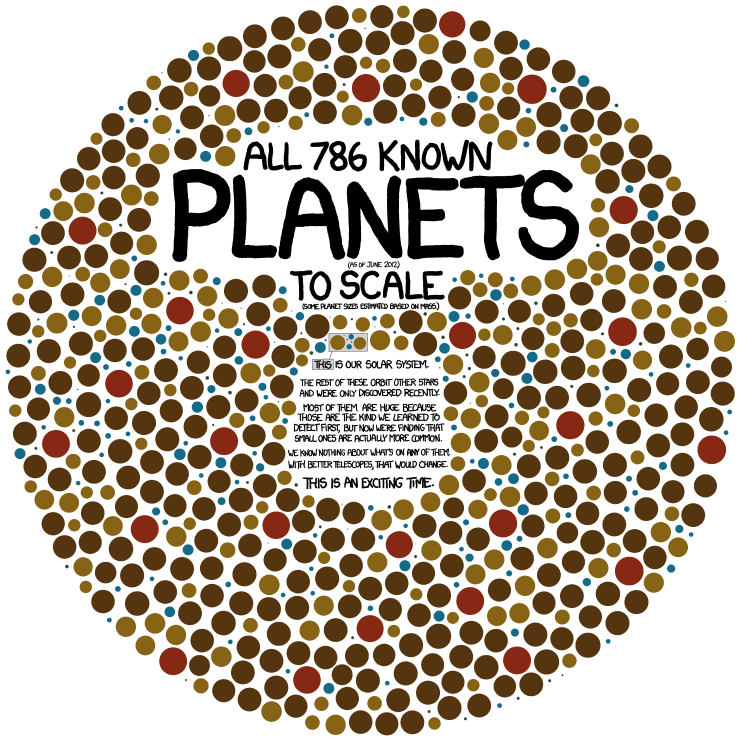
of finding new extrasolar planets of course. Are you as excited as the protagonist in this wonderful xkcd comic below?
Monday, August 30, 2010
Monday, August 23, 2010
Yet another way of finding planets around other stars
Instead of just measuring the dip of light from a star by a planet passing between us and it, measure the time of this dip occurs and look for changes around the orbital period resulting from the gravitation tug of a different planet in this system. It is called "Transit Timing Variation," and you can read more about it here.
Wednesday, August 4, 2010
Stormy Exoplanets
Not only (with very large optical telescopes and lots of observing time) is it possible to determine the chemical composition of the atmosphere of a planet observing another star, but it is possible to study its weather as well. Wow! Go here to read all about it.
Wow!
Thursday, July 29, 2010
Saturday, May 8, 2010
Nine New Exoplanets
Not a line in the Astronomer's version of the "12 Days of Christmas" song, but an actual discovery. Go here to read more. I know that they are now over 100 exoplanets known, but I still find it fascinating and amazing that we can detect tiny planets around distant stars.
Wednesday, April 7, 2010
Most misleading Astronomy press release...
.... I've seen in a while. Go here to read it. The planet that was discovered is interesting, but all the speculation at the end? Ugh. It just really annoyed me for whatever reason. Feel free to disagree with me below. Of course, I am posting about it, which is probably all they wanted....
Sunday, March 21, 2010
Hubble: Planet Discoverer
The telescope, that is. Go here for more. Seriously, what was NASA thinking when they talking about shutting Hubble down prematurely?
Sunday, March 7, 2010
Little telescope...
... big exoplanet. Go here to read how an old, fairly small, NASA-run telescope in Hawaii was able to measure the properties of the atmosphere of a planet in another solar system. Enjoy!
Wednesday, February 24, 2010
Measuring the atmosphere of another planet...
... is easy using current technology - if the planet is in our Solar System. Around another star, well, that is something else entirely. Go here to read how this was recently accomplished for a planet orbiting a nearby star. Impressive.
Saturday, February 13, 2010
New exoplanets from Kepler
I definitely plan to have a future show on this (yes, I still plan on doing those. One day. Hopefully soon. When I get a chance. Sorry) but, until then, read this article about five!! new extra-solar planets discovered already by Kepler. These are not the Earth-sized planets in Earth-like orbits that Kepler was designed to discover (those, by definition, orbit their star once a year so Kepler hasn't been in space long enough to detect those - yet) but still very interesting. Enjoy!
Saturday, January 30, 2010
JWST and Exoplanets
As NASA works on constructing the James Webb Space Telescope, the successor to the Hubble Space Telescope, astronomers are thinking of what science questions it can possibly answer. Go here to read an article on what it can do to the field of extra-solar planet research.
Thursday, June 11, 2009
NY Times Article on Transiting Planets
Here is a pretty good article on the search to find another Earth-like planet around a Sun-like star (you know, in addition to the one we live on.). Enjoy!
Subscribe to:
Posts (Atom)

 Posts
Posts


