NASA's Deep Impact spacecraft, on its way to its rendezvous with Comet Hartley 2, recently filmed this video of the Moon "transiting" the Earth - essentially passing between the Earth and this spacecraft, absorbing some of the light being emitted by the Earth. This technique has proven invaluable in detecting and studying planets orbiting other stars, and in fact Deep Impact is currently looking for an Earth-size transiting planet around red dwarf GJ436, as part of the EPOCh project. Enjoy!
Thursday, July 24, 2008

NASA/ESA Plan for the Moon
NASA's plan to return to the Moon and establish a permanent base while NASA-led, is not NASA's alone, and if it happens is going to probably involve a lot of cooperation between NASA and other space agencies, especially the European Space Agency (ESA). To that end, NASA and ESA have been working together trying to figure out where it would make sense for this cooperation to occur, and the first document discussing this is available here. Regardless of what you think about NASA's focus on returning people to the Moon and eventually sending them to Mars, the process is interesting - at least to me.
Hope you enjoy. Please leave comments below, I'd love to read your thoughts about this issue.
Friday, July 18, 2008
July 9th radio show description
Already available here, below is the description of what I talked about on the July 9th radio show:
- News: The next sample to be tested by the Thermal and Evolved-Gas Analyzer (TEGA) on the Phoenix Mars Lander to be rich is sub-surface ice, one the ovens that comprise the TEGA has a short circuit most likely the result of all the shaking done early to get a sample in there (link); International Astronomical Union decides to call pluto-like objects "plutoids" (link); Ulysses spacecraft still functioning - fuel lines were expected to freeze on 1 July; Rosetta spacecraft en route to a rendezvous with a comet is preparing to study a rare type of asteroid; main mirror for new airplane-hosted infrared telescope SOFIA has been made; first underwater detector for high energy neutrinos coming from space, Antares, is complete (link); thanks to infusion of money from recent supplemental budget passed by Congress, Fermilab cancels layoffs; congratulations to the winners of NASA's aircraft design competition (link); European Space Agency announces an opportunity for graduate students to conduct an experiment in zero-gravity for their thesis (link); NASA considering developing a program to teach university students how to develop a satellite (link); NASA debuts website devotes for first test flight of the Ares spacecraft - the replacement of the space shuttle (link); new swimsuit being used at the Beijing olympics was tested at NASA's Langley Research Center (link); meeting from July 9-10 in Paris to discuss a mission to Mars that would return a sample to the Earth (link); NASA TV to broadcast upcoming spacewalks (sorry, already happened); European Space Agency to host an Internal Space Station Heads of Agency meeting on July 17th to discuss future activity; Swedish gym for astronauts currently being tests on the International Space Station (link); mysterious acronym on extra-solar planet website believed to hold clue to new discovery; Doritos broadcasts first advertisement into outer space (link); Slovenia signs cooperation agreement with European Space Agency; Austria has joined European Southern-Hemisphere Observatory (ESO)
- Calendar of upcoming astronomy and science events in the greater Poughkeepsie/New York City area
- Return to Moon and Mars: A lot of technological development is required for this since much of the old technological capabilities have essentially been lost, including a new generation of spacesuits (link), a new lunar module breathing system which was just tested for the first time (link), new moon buggies, which NASA has been exhibiting and inviting teams to design their own and race (link, link) with ESA have their own competition (link). Before humans can return to the Moon and establish a permanent base their, more detailed mapping of the lunar surface and subsurface needs to be completed - goal of Lunar Reconnaissance Orbiter (LRO) and Lunar Crater Observation and Sensing Satellite (LCROSS) to be launched later this year. Also need a study of what is required for a moon base, which was reviewed on June 20th. High resolution radar images of Moon's South Pole - a possible place to land people and build a moon base, waere released earlier this year (link). ESA's SMART-1 also doing this (link), and NASA devloped a laser radar technique to get even finer maps of lunar surface (link). NASA to launch in 2011 a mission to measure distortions in the gravitational field of the Moon caused by mass concentration underneath craters called "GRAIL", and will look for subsurface on the Moon with LRO. Once on the surface, moon dust would be a problem for humans and rovers because it is very fine, scratchy, and sticky due to its electrical charge as a result of the Solar Wind - cause be highly carcinogenic (link). Moon dust almost derailed an Apollo 17 rover, but duct tape saved the day. When/If people return to the Moon, NASA plans on doing some Astronomy there as well, has recently issued a called for proposals (link). Moon passes through Earth's magneotail, which also charges moon dust, can cause lunar dust storms, and is a process that is bizarre and one of things NASA hopes to study when people return (link). Giant crater at bottom of Moon might hold key to understanding period or intense bombardment in early Solar System, as well as seeing meteors crashing into Moon today. Reanalysis of Apollo 12 relic yield understanding on lunar "soil", which is a collection of the remains of past meteorites to hit the lunar surface. Moon also a good place to do very low frequency radio observation of the cosmos, since no ionosphere or interference like FM radio stations to worry about(link). Might also be possible to make a giant optical mirror on the moon using moon dust (link). Sun is expected to vaporize Earth when it enters its Red Giant phase of evolution (link) - providing incentive for humanity to leave the Earth in the next billion years or so.
Thursday, July 17, 2008
Neutron Stars at COSPAR 2008 blog
There is a live blog on the neutron star sessions at the COSPAR 2008 conference in Montreal which I am currently attending. There are lots of interesting results on neutron stars which have been and will be presented at a meeting, so feel free to go over there and read about it as it comes in. (Shameless plug: I'm also going to be giving a talk in this session this afternoon. I did miss this week's radio show for a real reason). Hope you enjoy, and feel free to email me or post below any questions you might have, as well as post them on the neutron star blog above.
Monday, July 14, 2008
July 9th radio show - Return to the Moon and Mars
Available here is the July 9th episode of this radio show. This was devoted to discussing the latest news and progress concerning NASA's return to the Moon and Mars. I'm currently in Montreal for an astronomy conference (COSPAR 2008 if you are interested) so I can't post a full synopsis now, but hope to do so soon.
Enjoy!
Monday, July 7, 2008
July 2nd radio show - Asteroids and Comets
The July 2nd radio show is now available here for your listening pleasure. Since June 30, 2008 was the 100th year anniversary of the Tunguska event, this show was devoted to the history of asteroids and comets impacting on the Earth. On this program, I talked about:
- Phoenix Mars Lander:
- 24 June - returns sample to Optical Microscope for closer examination (link);
- 25 June - first sample placed in the Microscopy, Electrochemistry, and Conductivity Analyzer, a wet chemistry laboratory (link);
- 27 June - Preliminary results from MECA analysis indicate soil is similar to that found in upper, dry valleys in Antarctica, and Thermal and Evolved-Gas Analyzer (TEGA) which bakes its samples up 1800 degrees Fahrenheit almost done with its first analysis (link);
- 29 June - Robotic arm reaches icy soil in a trench (link)
- News: Ulysses mission expected to end on July 1 (link); NASA begins development of a spacecraft to probe the Sun's corona called "Solar Probe+" (link); NASA expected to launch a prototype of a solar sail - a spacecraft which literally uses sunlight to move (link), recent book on the subject titled "Solar Sails: A Novel Approach to Interplanetary Travel" by Giovanni Vulpetti, Les Johnson, and Gregory L. Matloff; Lunar Cross Observation and Steering Satellite (LCROSS) passes major pre-launch tests (link; Herschel, next generation infrared telescope from the European Space Agency, passes acoustic and vibration pre-launch test; SOHO discovers its 1500th comet; Cassini celebrates 4 years around Saturn, completing its "prime mission", and now begins its extended mission (link); Congrats to Michael Keefe (Sciutate, MA), Matt Pleatman and Noan van Valkenburg (Bloomfield Hills, MI), and Ben Basalik (Collegeville, PA) for winning NASA's Cassini Scientist-for-a-Day contest; congrats to Jackson Warley (Colorado Springs, CO; 1st prize), Grace Nowadly (Williamburg, VA; 2nd prize), and Megha Subramanian (Hershey, PA; 3rd prize) for winning NASA's 50th Anniversary Essay Competition; congrats to Prof. Reinhard Genzel (MPE; UC-Berkeley) for winning the Shaw Prize for Astrophysics due to his group's measurements of stars orbiting the center of Milky Way, proving it is a black hole; congrats to the graduate students in Lockheed Martin's Engineering Leadership Development Program was setting the world amateur high-altitude balloon record (link); congrats to NASA's Automatic Dependent Surveillance-Broadcast (ADS-B) team for winning the Robert J. Collier Trophy; congrats to the International Space Station for staying in orbit for 10 years; congrats to the scientists involved on the High-Resolution Soft X-ray Spectrometer (SXS) and the Global-Scale Observations of the Limb and Disk (GOLD) missions, chosed to be NASA's next Explorer programs; congrats to the recepients of NASA's Experimental Program to Stimulate Competitive Research (link); congrats to Fermilab, SLAC, NASA, and NIH for getting more money - needed to stave off layoffs at these facilities; NASA/Pixar introduce new WALL-E public service announcement; NASA introduces 50th anniversary card game (link)
- Calendar of upcoming Astronomy events in the greater New York / Poughkeepsie area
- Tunguska Event: Early Morning on 30 June 1908, a giant fireball and explosion was seen near Vanavara, Siberia, Russia which knocked down trees, blew down houses, but didn't leave a crater. While many different ideas were proposed, including aliens, anti-matter, and miniature black holes, it is now believed to have been an asteroid which broke up before it hit the ground. In the 2008 June 26 edition of Nature, there are articles discussing Tunguska, as well as past (Spaceguard) and future projects devoted to detecting Near-Earth Asteroids. On such project is NEOSSat, a Canadian satellite devoted to discovering such objects (link). Iowa State recently established Asteroid Deflection Research Center (ADRC) to study how to divert such an asteroid (link). Planet finder SuperWASP serendipitously observed brightening of Comet Holmes in October 2007 before it was first reported (link). Analysis of comet dust material falling to Earth discovered a new material (link), analysis of asteroid discovers chemical precursors of RNA and DNA (link), new analysis of an asteroid discovers it contains material from the very formation of the Solar System (link).
Very Large Array
Last month I was at the Eleventh Synthesis Imaging Workshop run by the National Radio Astronomy Observatory (NRAO) on how to reduce data from a radio interferometer. The summer school was located in Socorro, NM which is located near the Very Large Array (VLA),the world's premier radio astronomer. As part of the summer school, we got a guided tour of the VLA - which was pretty awesome - and here are the pictures:
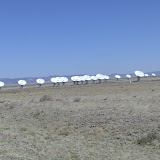 |
| Very Large Array |
Hope you enjoy them, and get a chance to visit the VLA yourself.
Ask the Science Times a question
Dennis Overbye, the senior science writer at the NY Times, is taking questions from readers from today (July 7) to July 11, 2008. Email him here to ask a question. Of course, if you have an Astronomy question, you can always ask me via email or by leaving it below. You can even ask the same question to both of us, and compare answers!
Thursday, July 3, 2008
Planet Alignment July 4th weekend
In addition to fireworks (in the US), the planets will be throwing a show this weekend. Friday night, Mars and Saturn will be very near each other and the star Regulus. On Saturday night, the Moon joins the fun. For more info, read this NASA article and/or spaceweather.com.
Also, this July 4th the Earth reaches its maximum distance from the Sun, called the "aphelion" - further proof that the seasons are caused by the Earth's tilt and not distance from the Sun, because it is expected to be a hot July 4th (at least around New York City). More proof is that while it is summer in the Northern Hemisphere it is winter in the Southern, but that is another show.
Hope you have a fun (and safe) 4th of July!
Tuesday, July 1, 2008
Interview with Dr. Charles Meegan online
Subscribe to:
Posts (Atom)

 Posts
Posts


